
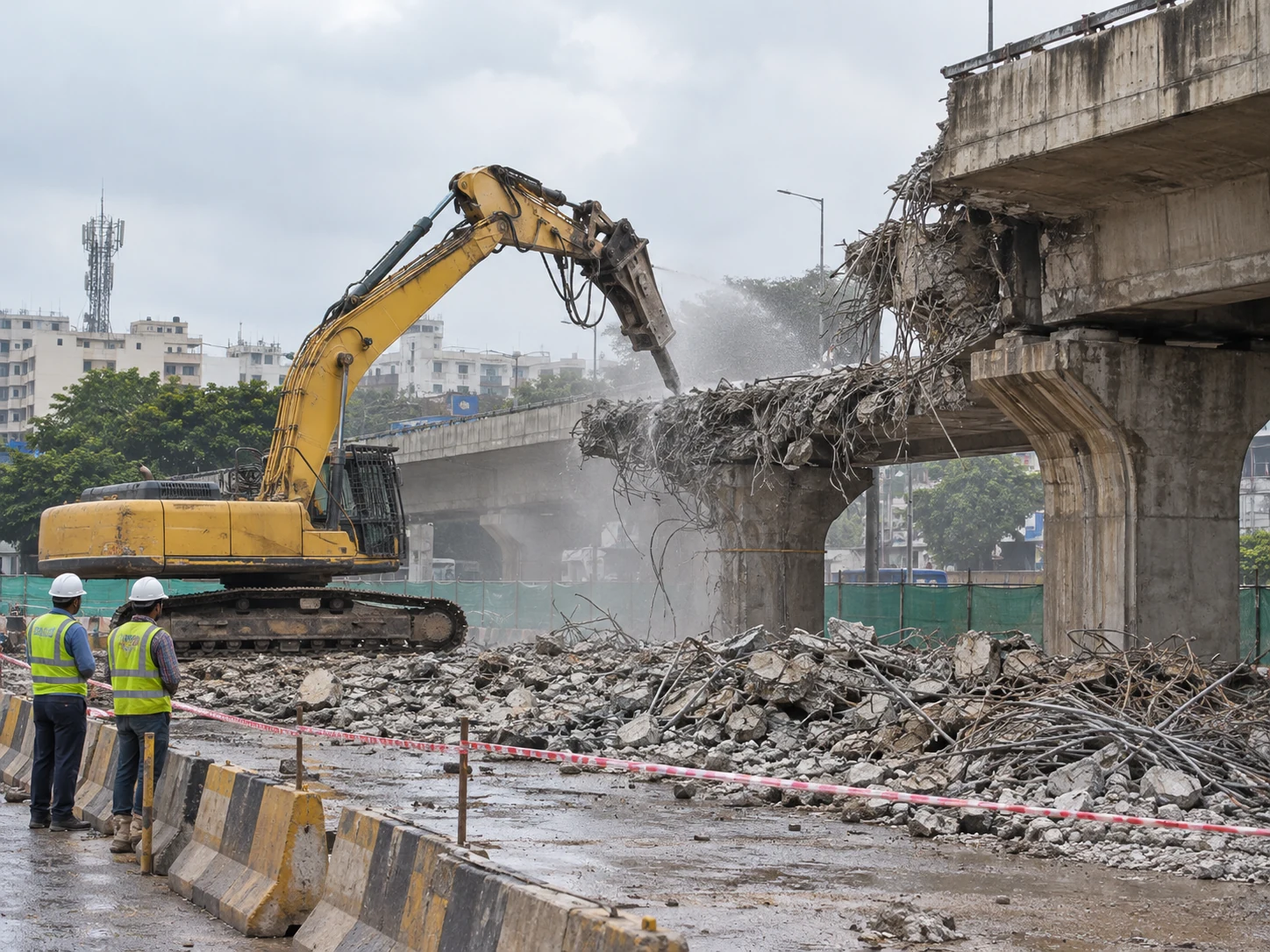
Tell us what needs to come down.
Share the structure, location and constraints. We will discuss feasibility and the next step before arranging a visit.
Request a site assessment
Fields marked * are required.
A controlled sequence, never a standard template.
Every infrastructure structure needs its own scope, removal method and access plan before work starts.
Share the structure details
Tell us the location, structure type, approximate dimensions, ownership, constraints and intended programme.
Site assessment
We review construction, condition, nearby roads or assets, utilities, access and material movement.
Method and quotation
The proposal sets out the assessed work, engineering requirements, protection, debris scope and terms.
Controlled removal
After approvals, utility isolation and site arrangements are confirmed, work follows the agreed sequence.
Clearance and handover
Debris and recoverable materials are handled as agreed, then the cleared area is reviewed.
What makes us unique
We plan from the real site outward. The method, protected assets and final handover are defined before equipment is mobilised.
No default demolition method
Concrete works, stadium stands, elevated tanks and bridges are each assessed for their condition, access and removal sequence.
Attention to what stays in use
Road access, connected services and adjacent structures are considered when defining the work boundary and controls.
A handover without guesswork
The written scope distinguishes retained elements, recovered materials, debris clearance and the agreed final condition.
What infrastructure demolition involves
Infrastructure demolition removes or reduces public-facing and heavy civil structures such as bridge sections, elevated tanks, stadium stands and reinforced concrete works.
Engineering review, authority requirements, utilities, traffic and protection of nearby assets must be considered before a sequence is approved. Some projects need temporary supports or specialist lifting, subject to assessment.
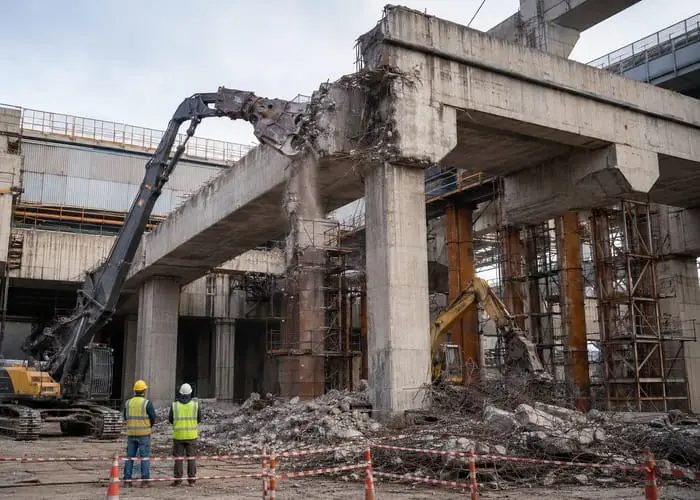
What can be removed
Full and partial removals are assessed individually. The quotation identifies limits, retained elements, debris movement and final ground condition.
- Heavy RCC beams and slabs
- Concrete columns and piers
- Bridge decks and parapets
- Flyover spans and supports
- Stadium seating and stands
- Stadium roof and concourse elements
- Overhead RCC tank bowls
- Tank staging and supports
- Retaining and boundary structures
- Foundations, where assessed
- Steel and attached fixtures
- Reinforcement segregation
- Controlled concrete breaking
- Debris loading and transport
Infrastructure demolition services
Choose the service closest to your project. A site assessment confirms a suitable method and the exact scope.
Heavy concrete structural demolition
Heavy RCC elements dismantled in assessed sections with controlled breaking, protected work areas and debris removal.
Discuss this service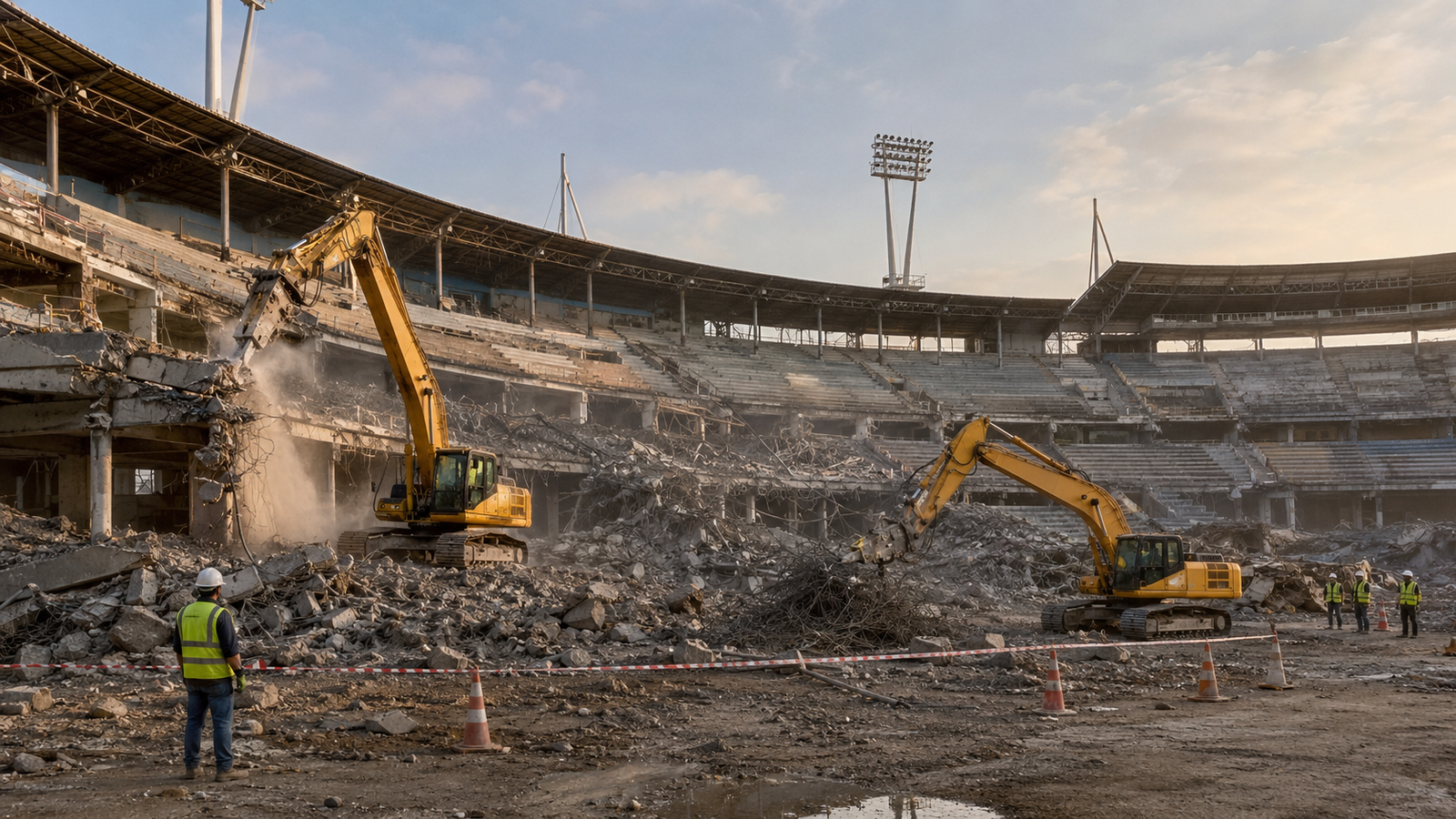
Stadium demolition services
Stands, seating structures and associated concrete works removed to a planned sequence with controlled site access.
Discuss this service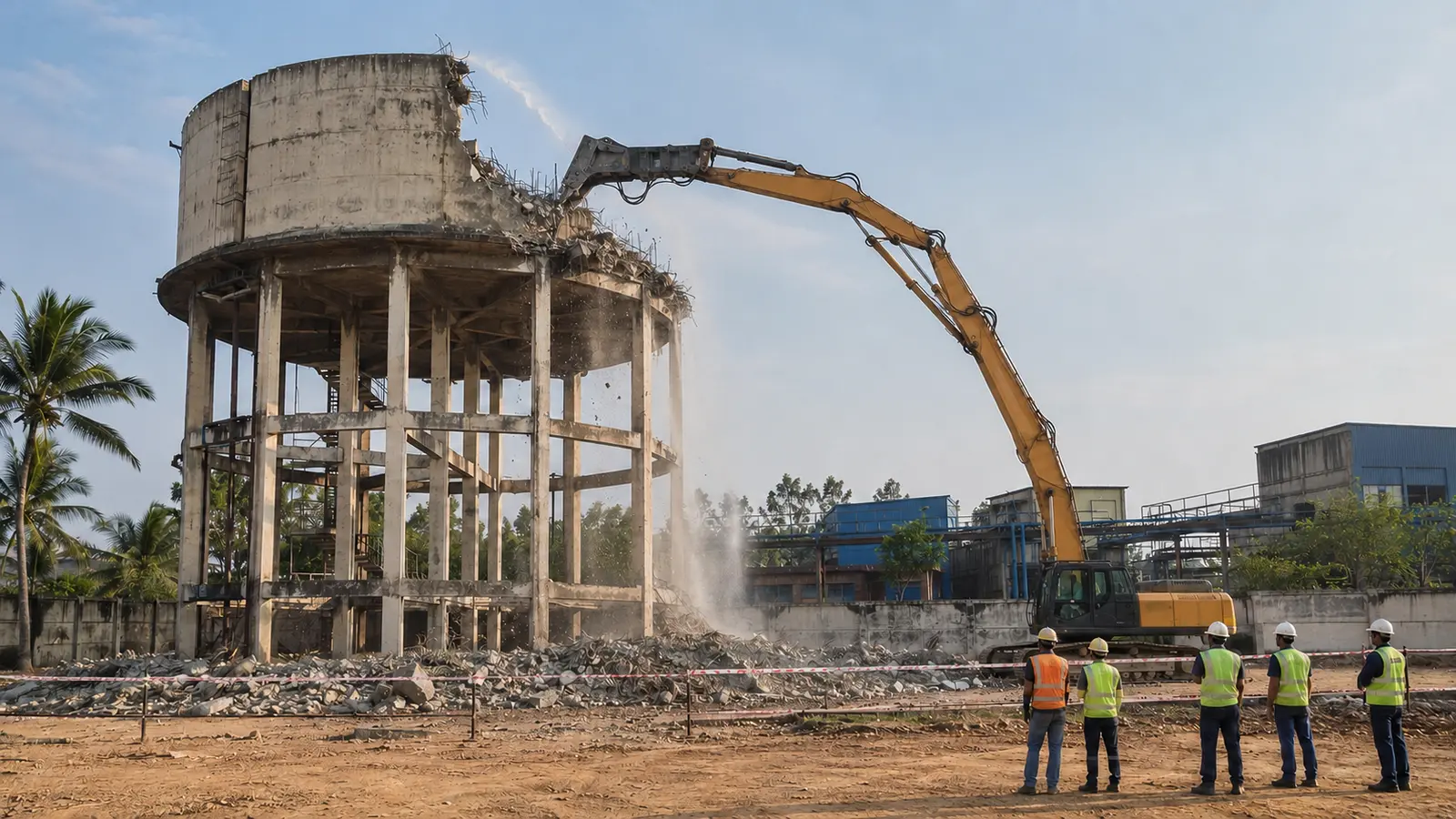
Overhead RCC water tank demolition
Elevated tanks assessed for isolation, draining, secured work zones and section-by-section lowering.
Discuss this service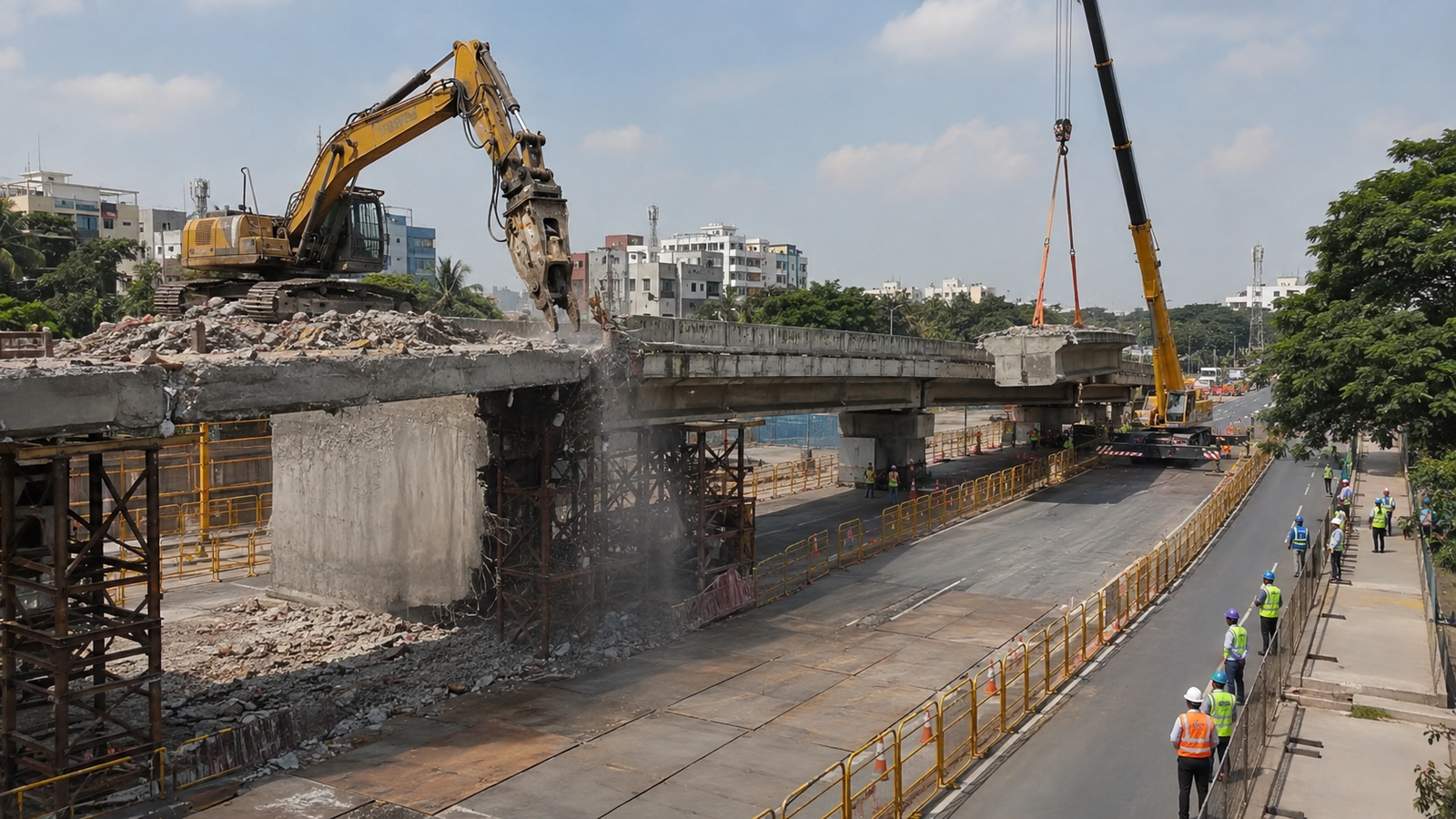
Bridge & flyover demolition
Decks, piers and connected structures assessed around access, traffic coordination, utilities and debris routes.
Discuss this serviceFull removal or selective works?
The distinction affects engineering, retained assets and the final handover. A site assessment confirms which approach is suitable.
Clear the whole structure
For structures that must be removed in full, the scope identifies every element to leave the site and what remains below ground.
- Confirm decks, supports, attached structures and limits.
- Agree foundation depth and required ground condition.
- Record ownership of recovered steel and other materials.
Keep part of it in use
When adjoining sections or services must remain, the retained structure and removal interface need separate technical review.
- Mark the elements, routes and services to retain.
- Share interface drawings and known structural changes.
- Assess stability and any required temporary support.
Not sure which applies? Share the available drawings and site details. Neither route is final until the technical method and applicable approvals are confirmed.
What to share with us
A few practical details help us understand the structure and identify what needs checking on site.
- Drawings and recordsStructural plans, as-built drawings and known alterations, if available.
- Utility informationWater, power and other connected services, plus any known isolation status.
- Owner and authority contactsWho controls the structure, site access and applicable permissions.
- Access and site photosVehicle routes, lifting space, nearby roads and clear images of the structure.
- Nearby operationsPublic routes, adjoining assets or services that must remain in use.
- Handover and timingWhat must stay, the clearance level required and your intended deadline.
No complete drawing set? Share what you have. The site assessment can identify what needs further confirmation.
Planned around what stays in use.
A bridge deck, stadium stand and elevated tank cannot follow the same removal sequence. We assess stability, lowering routes, access and the surrounding public interface before work begins.
Engineering and temporary works
Structural changes and temporary works need project-specific review by appropriately qualified professionals.
Traffic and public interface
The relevant authority or asset owner must approve applicable closures, diversions and access arrangements.
Utilities and protected zones
Affected services need isolation. Live facilities, overhead lines and neighbouring assets call for defined controls.
Clearance to a defined finish.
The quotation states what leaves the site, who owns recovered materials and the exact level of clearance required.
Materials handled as agreed
Concrete, reinforcement and other materials are separated where the work and site allow. Recoverable steel may have value after inspection, but does not automatically make demolition free.
A clear handover boundary
Loading, transport, receiving arrangements and the final site condition are agreed before removal. Foundation removal, reinstatement and new construction are separate unless included.
A price built around your project.
Infrastructure demolition is not priced by size alone. Each quotation reflects the structure, the removal method, the site constraints and the condition in which the site must be handed back.
Request an itemised scope- 01Structure and conditionConcrete thickness, reinforcement, height, spans and connections.
- 02Engineering methodSequencing, temporary works, lowering or lifting requirements.
- 03Access and public interfaceMachinery routes, roads, rail, nearby assets and exclusion zones.
- 04Utilities and approvalsIsolation, surveys, permits and authority coordination.
- 05Debris movementBreaking, sorting, loading, transport and receiving arrangements.
- 06Handover levelFoundation removal, retained elements and the agreed site condition.
Check scope limits, responsibilities, programme, material ownership, clearance and payment terms before approving the proposal.
Where we assess projects
BCM assesses infrastructure demolition enquiries in Bengaluru and across Karnataka. Feasibility depends on the structure, location, available records, access, public interface and required approvals.
See BCM projects and case studies or read more about BCM Demolition Group.
Infrastructure demolition FAQs
Clear answers on scope, permissions, live services and what a site assessment confirms.
Can you demolish a complete bridge or flyover?
We assess full and partial bridge or flyover removal. The method depends on structural engineering, permissions, traffic, utilities, access and nearby assets.
Can an overhead tank be removed while it is still in use?
Water supply and connected services must be safely isolated and the tank drained before demolition. The responsible owner should plan any replacement supply.
Do you demolish stadium stands in phases?
Phased dismantling may be considered after reviewing the structure, access, adjoining areas and a suitable demolition sequence.
Can you work beside a live road?
Only when the work can be planned with suitable protection and any required traffic or authority arrangements. These are confirmed before work starts.
Do you remove foundations and supports?
They can be included after inspection. The exact depth and extent of removal must be stated in the quotation.
Who disconnects utilities?
Responsibilities for isolating power, water and other affected services are agreed before mobilisation and included in project arrangements.
Who obtains the required permissions?
Applicable approvals and the responsible party are confirmed for each project. No demolition should begin before required permissions are in place.
Is debris removal included?
Debris loading, transport and clearance can be included. The quotation confirms what leaves the site and the handover condition.
How is the project priced?
Price depends on the structure, method, access, controls, debris and agreed scope. We prepare a quotation after assessment.
Do you work outside Bangalore?
Yes. Suitable infrastructure demolition projects elsewhere in Karnataka can be discussed.
Your project deserves a plan built for its site.
Share the structure, location and constraints. We will discuss the next step before anything is scheduled.